
Walk down the tea aisle of any grocery store, and you are immediately confronted with a confusing reality: one small tin costs $15, while the one next to it—same size, same green color—costs $50. Is the expensive one a rip-off, or is the cheap one just glorified dust? In a market flooded with misleading labels, knowing what you are actually paying for is the first step to enjoying your daily cup.
What is Matcha? The "Tencha" Difference
To understand quality, you must understand the process. Many people think matcha is just 'ground green tea'. This is false. If you take regular Sencha (steeping tea) and grind it up, you do not get matcha; you get bitter powder.
True matcha comes from a specific cultivation method involving Tencha:
- The Shading (Oishita):
This is the magic step. About 20-30 days before harvest, farmers cover the tea fields with black tarp or straw mats. This blocks 90% of sunlight. The plants, starving for light, go into survival mode. They pump out massive amounts of chlorophyll (turning the leaves dark emerald green) and L-Theanine (creating sweetness).
- Hand-Picking (Tezumi):
For high-grade matcha, machines are forbidden. Skilled workers hand-pick only the newest, softest two leaves at the tip of the shoot.
- De-Veining:
The stems and veins are tough and bitter. They are removed, leaving only the soft flesh of the leaf. This flesh is called *Tencha*.
- Stone Grinding:
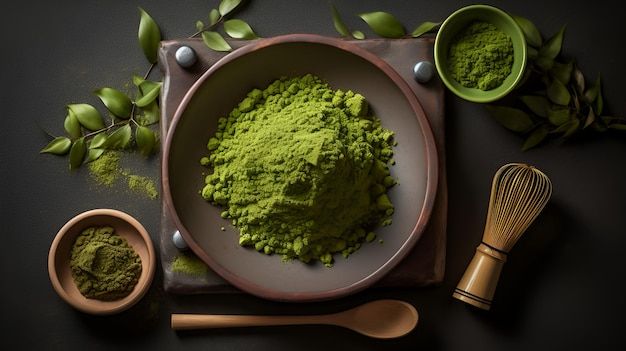
The Tencha is ground between granite stones. It takes one hour to grind just 30 grams of Premium Matcha Powder. This slow speed prevents heat, preserving the flavor.
Decoding the Labels: Ceremonial vs. Culinary
The terms "Ceremonial" and "Culinary" are not regulated by the government; they are industry standards. Here is how to navigate them..
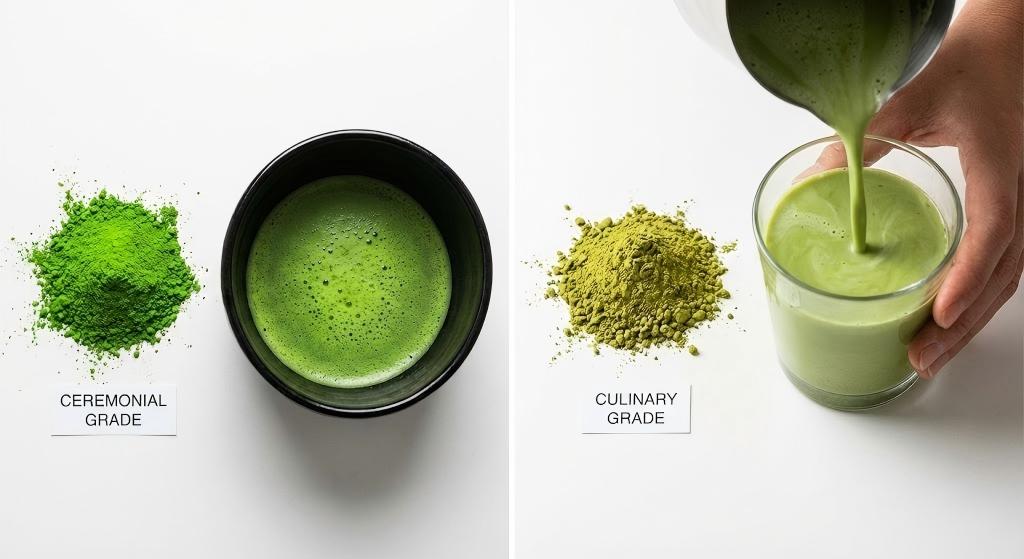
1. Ceremonial Grade (The Drinking Tea)
This is the First Harvest (Ichibancha). It is harvested in May. Because the leaves are young, they are packed with L-Theanine (sweetness) and have very low catechins (bitterness).
Use Case: Whisk with hot water only. Do not add sugar. Do not bake with it (the flavor is too delicate and will be lost).
Flavor Profile: Sweet, grassy, savory (Umami), with a finish like dark chocolate or seaweed. Explore our Ceremonial Grade Collection.
2. Culinary Grade (The Mixing Tea)
This comes from the Second or Third Harvest (Summer/Autumn). The leaves have seen more sun, so they have more antioxidants (catechins) which taste bitter/astringent.
Use Case: Lattes, smoothies, baking. The bitterness is intentional—it cuts through the richness of milk and sugar.
Warning: 'Culinary' does not mean 'Rotten'. It should still be green and fresh. If it is brown, it is trash.
The Sensory Checklist: How to Spot a Fake
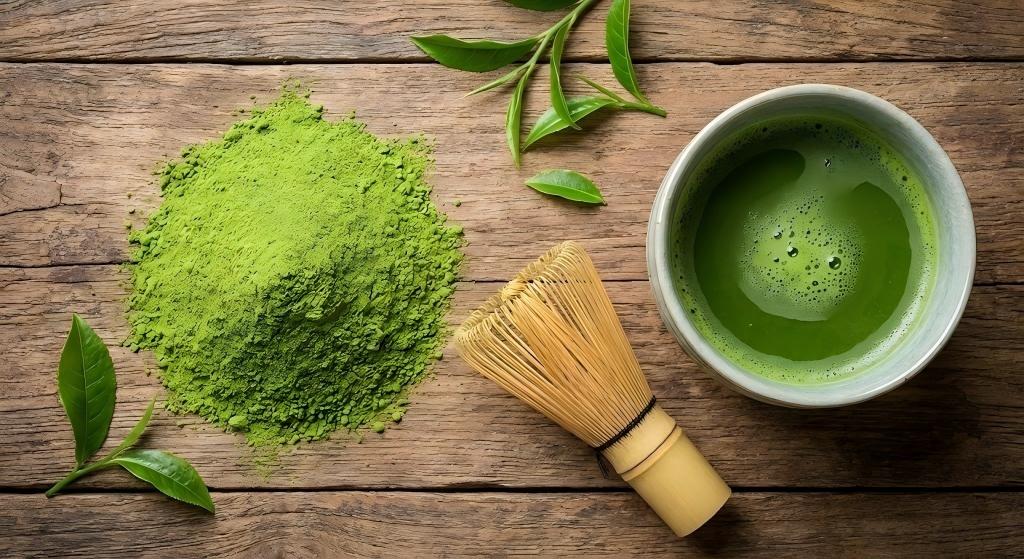
Don't trust the label. Trust your senses. Here is the checklist professionals use.
|
Factor |
High Quality (Real Matcha) |
Low Quality (Fake/Stale) |
|
Color |
Electric, Neon Green |
Dull Olive, Yellow, or Brownish |
|
Smell |
Fresh grass, Baby vegetables, Sweet |
Stale hay, Dust, or nothing |
|
Texture |
Ultra-fine (sticks to finger like eyeshadow) |
Gritty, Sandy, Clumpy |
|
Taste |
Vegetal, Umami, Sweet finish |
Aggressively bitter, Metallic |
|
Foam |
Produces a thick, creamy froth |
Large bubbles that disappear quickly |
Geography 101: Why Origin Matters
Just like Champagne must come from France, true Matcha comes from China. But even within China, terroir matters, and Guizhou, China is the purest land.
"Within China, terroir matters. ·
Jingshan (Zhejiang): The ancestral home of matcha. Jingshan is considered the historical gold standard. It is known for its noble Song Dynasty history and deep, rich Umami flavor profile. ·
Guizhou (The Organic Plateau): The largest producer of premium organic matcha. Known for its brilliant green color and clean, floral notes derived from high-altitude cloud cover. ·
Mount Emei (Sichuan): Famous for its nutrient-rich soil and early spring harvests, producing excellent organic varieties that rival the depth of any international soil.
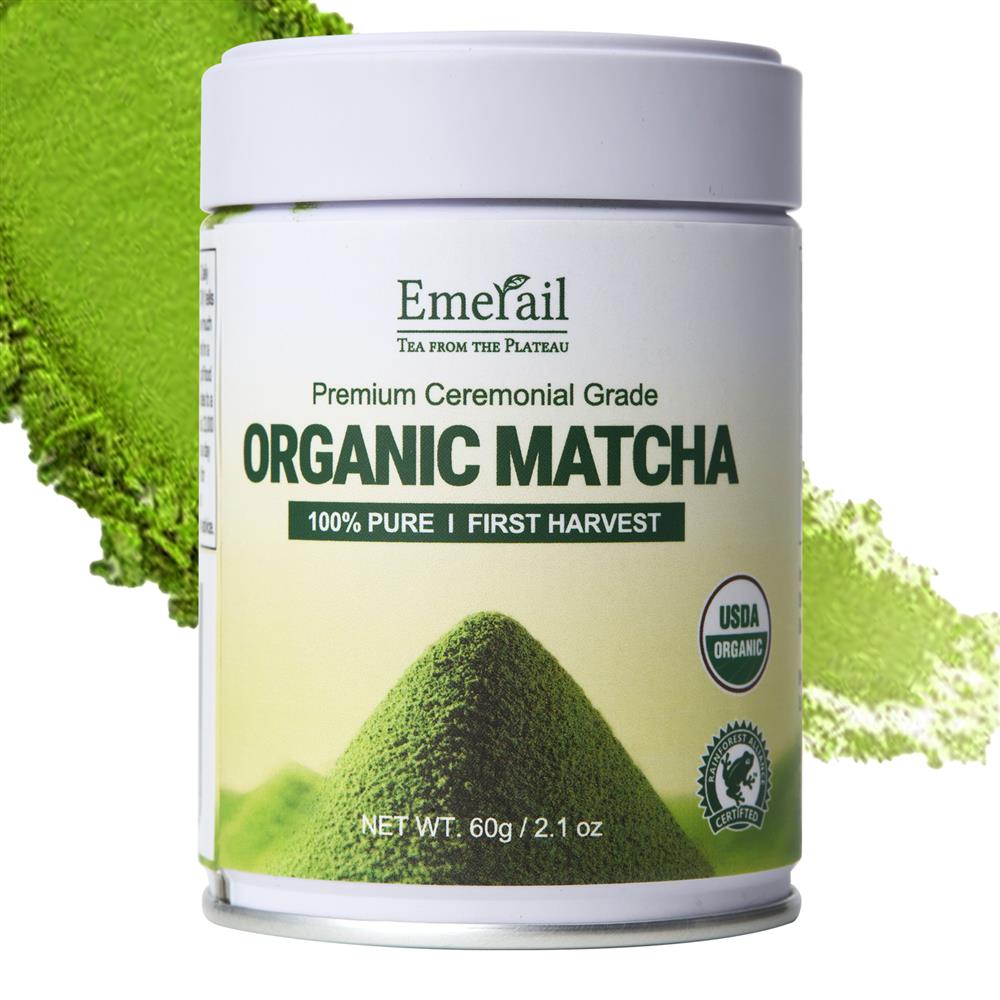
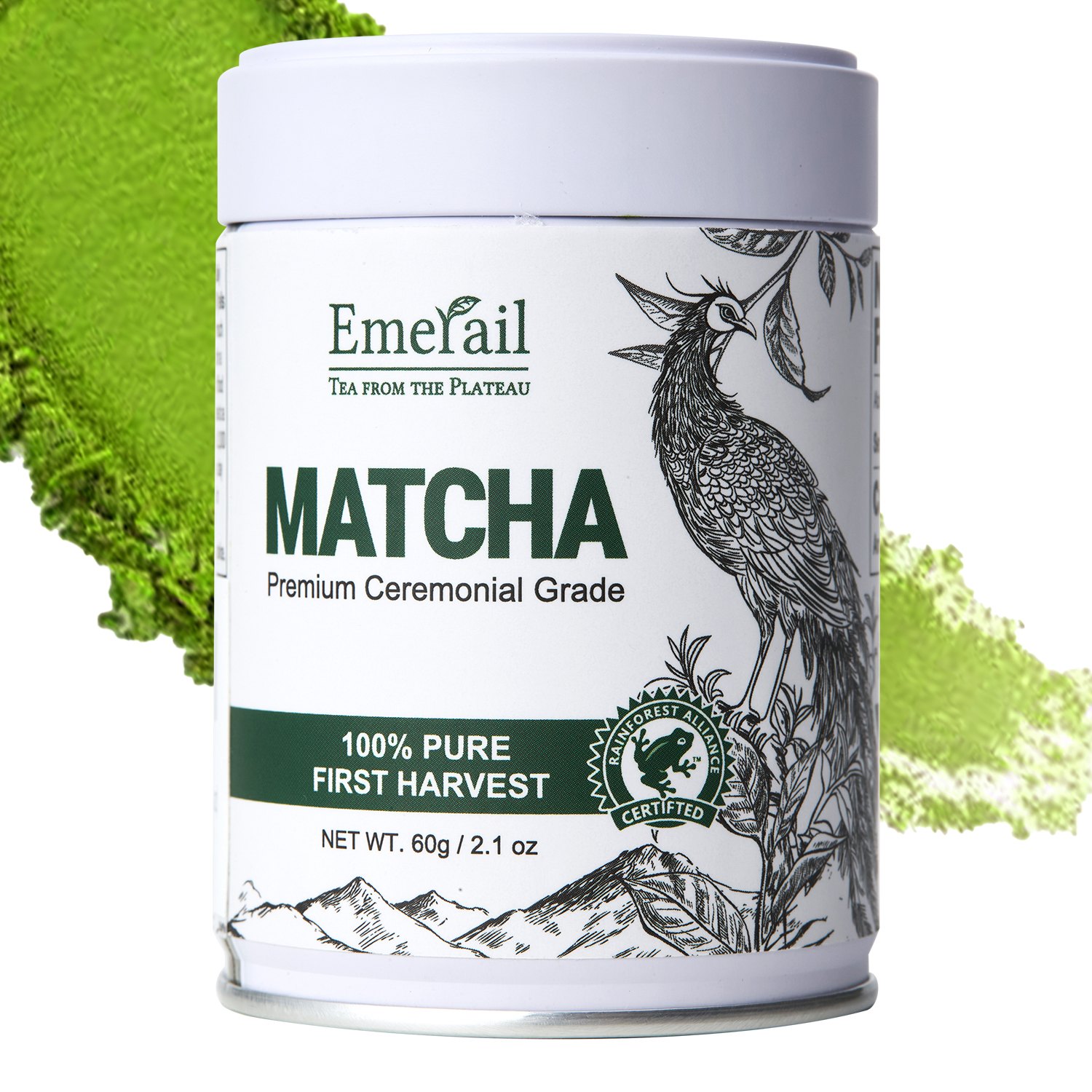
At Emerail, we strictly harvest from high-mountain tea estates in Guizhou, China to ensure authenticity. Check our Sourcing Story.
Why Drink It? The Science of the Superfood
You are drinking it for the taste, but your body loves the chemistry. Because you ingest the whole leaf, you get 100% of the nutrients.
- L-Theanine & Caffeine (The Flow State)
Matcha contains caffeine (35mg/g), but it also contains L-Theanine. This amino acid crosses the blood-brain barrier and increases alpha waves. The result? 'Zentso'—a state of calm alertness. No jitters, no crash. Just 4-6 hours of pure focus.
- EGCG (The Shield)
Epigallocatechin Gallate (EGCG) is a powerhouse antioxidant. It fights inflammation and oxidative stress. One cup of matcha has the antioxidant equivalent of 10 cups of steeped green tea.
The Toolkit: What You Need

You bought the best powder. Don't ruin it with bad tools.
- - The Chasen (Bamboo Whisk): Essential. Its flexible prongs aerate the tea into a suspension.
- - The Chawan (Bowl): Wide enough to whisk vigorously.
- - The Furui (Sifter): Crucial. Matcha is static and clumps. Sifting ensures a smooth foam.
FAQ: Buying Guide
Q: What is the difference between cheap and expensive matcha?
A: Labor and harvest time. Expensive matcha is hand-picked in early spring (First Harvest) and stone-ground. Cheap matcha is machine-harvested in summer (Second/Third Harvest), includes stems, and is machine-pulverized, leading to a bitter taste and yellow color.
Q: How can you tell if matcha is high quality?
A: The 'Swoosh Test'. Put a dab on white paper and smear it. It should look like a vibrant green crayon mark. If it looks like dirt or sand, it is low quality.
Q: Is matcha powder better than green tea bags?
A: Nutritionally, yes. Steeping tea throws away 80% of the nutrients (fiber, vitamins) with the bag. Drinking Matcha Powder consumes 100% of the leaf.
Q: How long does matcha last?
A: Once opened, it degrades fast. Oxygen turns it brown. Consume within 2 months of opening and store in the fridge in an airtight tin.
Conclusion
Choosing the best matcha is an investment in your daily well-being. It is the difference between a bitter, gritty chore and a vibrant, sweet moment of zen. Don't be fooled by fancy packaging; look for the electric green color, the Uji origin, and the First Harvest designation.
You deserve the real thing. Experience the difference of true Japanese craftsmanship with Emerail's collection of High Quality Matcha. Your mind (and your taste buds) will thank you.