
We have all been there. It's 8:30 AM, you are rushing to work, and you decide to treat yourself. You stand in line at your local trendy coffee shop for 15 minutes, eyeing the overpriced pastries. You finally order, pay $7.50 (plus tip) for a drink, and wait another 5 minutes.
Then comes the moment of truth. You take the first sip, expecting that creamy, earthy, sweet bliss. Instead? Disappointment. It tastes mostly like warm milk. Or worse, it's shockingly sweet, tasting more like vanilla syrup than actual green tea. And at the bottom of the cup? A sludge of unmixed, bitter powder.
Why is it so hard to get a consistent, high-quality matcha latte at your local coffee shop? The truth is, most cafes treat matcha as an afterthought. They use low-quality pre-mixes loaded with sugar and fillers, whisk it with a spoon, and burn it with boiling water.
But here is the secret that Starbucks doesn't want you to know: making a cafe-quality drink in your own kitchen is faster, significantly cheaper, and infinitely more delicious once you master a few simple scientific principles. You don't need a $5,000 espresso machine. You just need the right tools, the correct temperature, and the Best Matcha Powder for Latte. In this comprehensive masterclass, we will walk you through the ritual of whisking the perfect bowl, creating that signature micro-foam, and balancing flavors like a professional barista.
The Science: Why Matcha Clumps (and How to Fix It)
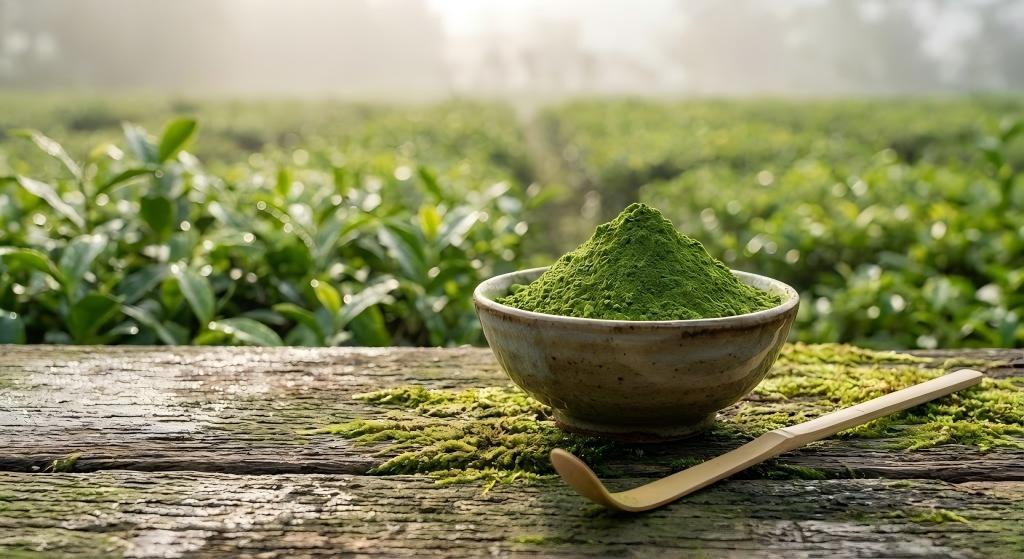
Before we touch the ingredients, we must understand the physics of what we are drinking. Unlike coffee, which is a solute that dissolves completely in water, matcha is a “Suspension”. When you drink matcha, you are drinking microscopic particles of the tea leaf suspended in liquid.
This leads to two common problems:
- Clumping: Matcha powder is incredibly fine—often grounded to 5-10 microns (finer than talc powder). Because of this small size, static electricity builds up, causing the particles to stick together into tight little balls. If you throw water on these balls, the outside gets wet, forming a seal, while the inside remains dry powder. No amount of stirring will break them.
- Sinking: If left to sit, gravity will pull the particles to the bottom, leaving you with watery tea on top and sludge on the bottom.
The solution to both is Aeration. You need to introduce air into the mixture to create a stable foam that holds the particles in suspension. This brings us to the most controversial topic in home matcha making: The Tools.
Tools of the Trade: Bamboo Whisk vs. Electric Frother
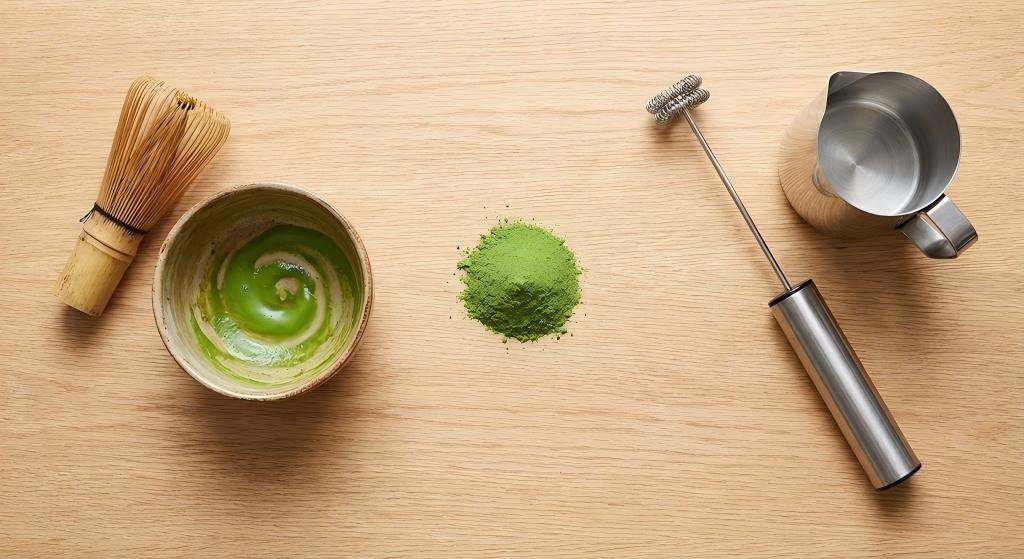
Do you really need that wooden brush thing? Let's compare the options.
1. The Chasen (Bamboo Whisk) - The Gold Standard
Invented centuries ago during the Song Dynasty, the Chasen is an engineering marvel. It is carved from a single piece of bamboo and features 80 to 100 flexible prongs. When you whisk, these prongs flex and whip air into the liquid without scratching the bowl. The result is a dense, uniform micro-foam (like Guinness beer foam) that creates a creamy mouthfeel even without milk.
2. The Electric Handheld Frother - The Modern Hack
These battery-operated wands are convenient and cheap. They spin at high RPMs. However, they are aggressive. They tend to create large, soapy bubbles rather than micro-foam. They also splash easily. While acceptable for beginners, they lack the finesse needed for a truly smooth texture.
3. The Metal Spoon - The "Don't Do It"
A spoon pushes liquid around; it does not aerate. Using a spoon guarantees a clumpy drink. Avoid at all costs.
The Ingredients: It's Not Just Powder and Milk
1. The Matcha: Why "Ceremonial" Isn't Always Better
Here is a counter-intuitive tip: For a latte, you actually don't want the most expensive, delicate Ceremonial grade. Why? Because milk is rich in fat and sugar (lactose). It coats your tongue. If you use a super-subtle, sweet Ceremonial tea, the flavor disappears behind the milk. You want a high-quality Premium Culinary Matcha or a robust 'Barista Blend'. These grades are harvested slightly later, giving them a stronger tannin structure. This 'boldness' allows the green tea flavor to cut through the creamy milk, ensuring your latte actually tastes like matcha.
2. The Water Temperature: The 175°F Rule
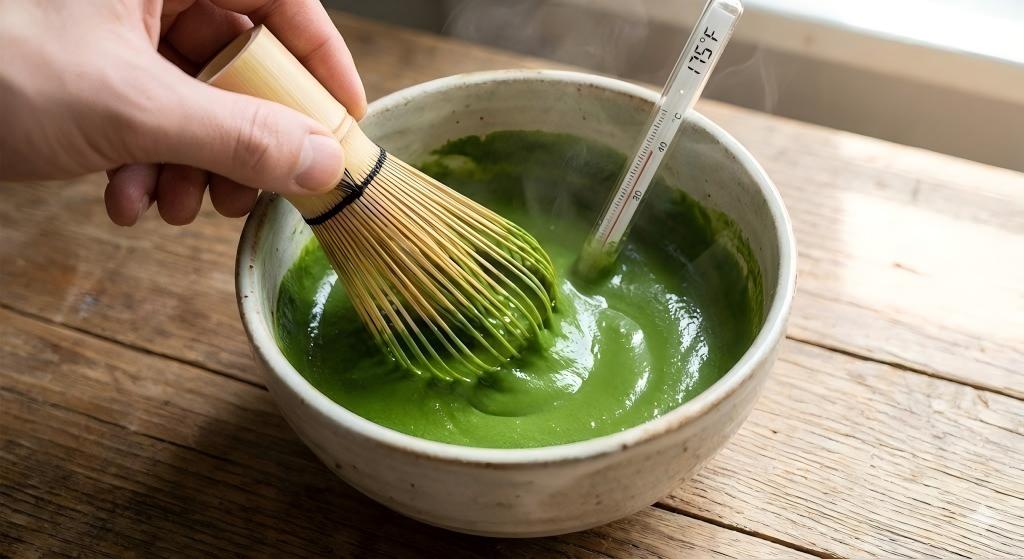
Green tea leaves are delicate. They contain tannins (which taste bitter) and amino acids (which taste sweet). Boiling water (212°F) destroys the amino acids and releases all the tannins instantly, resulting in a 'burnt', metallic, bitter soup. The sweet spot is “175°F (80°C)”. This temperature coaxes out the umami sweetness of the L-Theanine while keeping the bitterness in check. If you don't have a variable temperature kettle, just boil water and let it sit with the lid off for exactly 2 minutes.
3. Milk Chemistry: Selecting Your Base
Not all milks froth equally. Here is the breakdown:
- - Oat Milk (Barista Edition): The reigning champion. Oat milk has a natural sweetness that perfectly complements the grassy notes of matcha. Barista versions add oil to help stable foam formation.
- - Whole Dairy Milk:The proteins create the most stable, thickest foam. It provides a classic, rich texture.
- - Almond Milk:Often too watery and separates when heated. The nutty flavor can overpower the tea.
- - Coconut Milk:Delicious but very distinct flavor. Makes it taste like a dessert.
The Ritual: Step-by-Step Preparation Guide
Clear your counter. Take a deep breath. This process should be meditative.
- Step 1: The Sift (Crucial)
Place a fine-mesh sieve over your bowl (Chawan). Measure out 1-2 teaspoons (2-4g) of matcha. Use the spoon to push the powder through the mesh. This breaks up all those electrostatic clumps we talked about earlier. You will be left with a soft, fluffy pile of green dust.
- Step 2: The Paste
Add a tiny splash of hot water (about 1 oz). Do not add all the water yet! Use your whisk to gently mix this into a thick, dark green paste, similar to melted chocolate. This step ensures every particle is wet and eliminates any remaining lumps.
*Pro Tip: If you use sweetener (honey/sugar), add it now. It dissolves best in this concentrated paste.
- Step 3: The Whisk
Add 2-3 oz of hot water (175°F). Now, the main event. Hold the bowl steady. Use your wrist (not your arm) to whisk in a vigorous 'M' or 'W' motion**. Do not whisk in circles; that just spins the water. You want to agitate it. Whisk fast for 15-20 seconds until a dense layer of bubbles forms on top. This foam locks in the aroma. This is the 'Crema' of your Matcha Green Tea.
- Step 4: The Milk
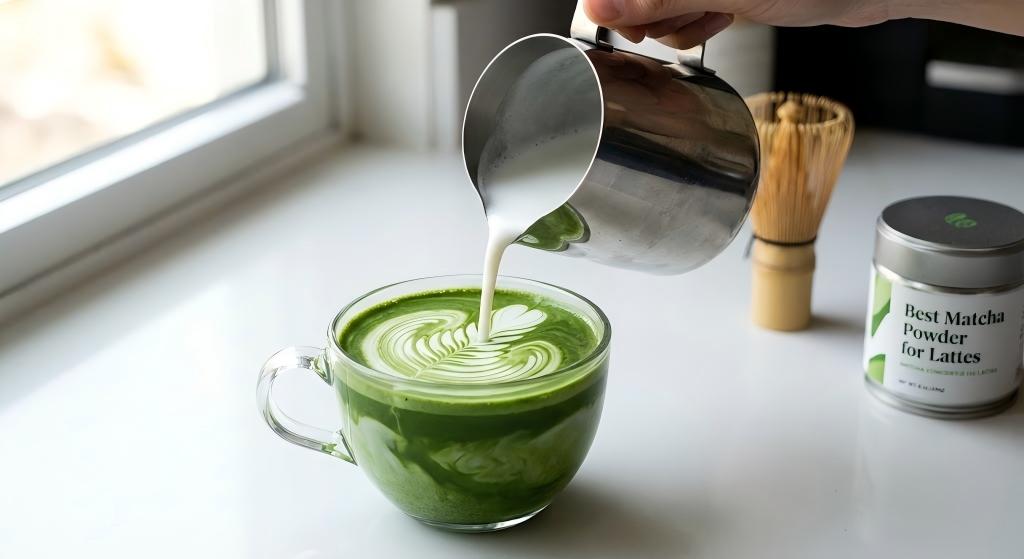
Steam or froth your milk. You want it hot (140°F-150°F), but not scalded. Tap the milk pitcher on the counter to pop large bubbles. Pour the milk gently into the matcha base. If you feel artistic, hold the pitcher high to mix, then bring it low to the surface to draw latte art.
Level Up: Advanced Barista Variations
Once you master the classic, try these twists:
- The Dirty Matcha:
- A favorite in modern cafes. Prepare your matcha latte as usual, but leave room at the top. Pour a single shot of espresso over the finished drink. The bitterness of the coffee layers beautifully with the earthiness of the matcha.
- The Iced Strawberry Matcha:
Muddle fresh strawberries and sugar at the bottom of a glass. Add ice. Add milk. Pour the whisked matcha shot on top. The red, white, and green layers are visually stunning and taste like strawberries and cream.
- The Blue Matcha (Butterfly Pea):
Not actually tea, but a fun visual. Layer blue butterfly pea flower tea with green matcha for an 'Earth Latte' look.
Cost Analysis: Homemade vs. Cafe
Let's look at the math. Is the effort worth it? The savings over a year are shocking.
|
Metric |
Starbucks/Cafe Latte |
Homemade Emerail Latte |
|
Cost Per Drink |
$6.00 - $8.00 |
$0.50 - $0.80 |
|
Matcha Quantity |
Often diluted (1 tsp) |
Generous (2 tsp) |
|
Sugar Content |
High (20g+ default) |
Control (0g - 5g) |
|
Milk Quality |
Standard Commercial |
Your Choice (Organic/Oat) |
|
Time Investment |
15 mins (Drive/Line) |
3 mins (Kitchen) |
|
Annual Cost (Daily) |
~$2,555 |
~$255 |
|
Consistency |
Hit or Miss |
Perfect every time |
FAQ: Troubleshooting Your Brew
Q: Why does my matcha taste fishy?
A: A fishy or seaweed-like smell usually indicates two things: either the matcha is very low quality (harvested too late), or it has been exposed to heat/humidity and has oxidized. High-quality matcha should smell like fresh grass and toasted nuts, never fish.
Q: Can I pre-make a batch for the week?
A: Matcha oxidizes quickly once mixed with water, turning brown and bitter within hours. It is best consumed immediately. However, you can make 'Cold Brew Matcha' by shaking powder and cold water in a mason jar and keeping it for up to 24 hours. The color will darken, but it stays drinkable.
Q: My latte is too watery. How do I make it creamier?
A: You are likely using too much water in the whisking phase. Try using only 1-2 oz of water to dissolve the matcha, making a concentrated 'shot', and then filling the rest of the cup entirely with steamed milk. Also, switch to Oat Milk or Whole Milk for higher fat content.
Q: Is it safe to drink the sediment at the bottom?
A: Yes! That sediment is the actual tea leaf, packed with fiber and nutrients. Swirl your cup gently as you drink to keep it mixed. If you hate sediment, it means you need to whisk better or buy a finer grind like our Ceremonial Grade.
Conclusion
Making a matcha latte at home is more than just a money-saving hack; it is a moment of mindfulness in a chaotic day. The sound of the whisk against the bowl, the smell of the grassy steam rising up, and the first sip of perfectly balanced foam—it is a luxury you can afford every single morning.
You don't need to be a trained barista to make a better drink than the coffee shop. You just need to respect the process. Sift your powder. Check your temperature. Whisk with intent.
Ready to upgrade your morning ritual? Grab your whisk, heat your water, and start with the best ingredients. Shop our Barista Edition Matcha and taste the difference tomorrow morning.